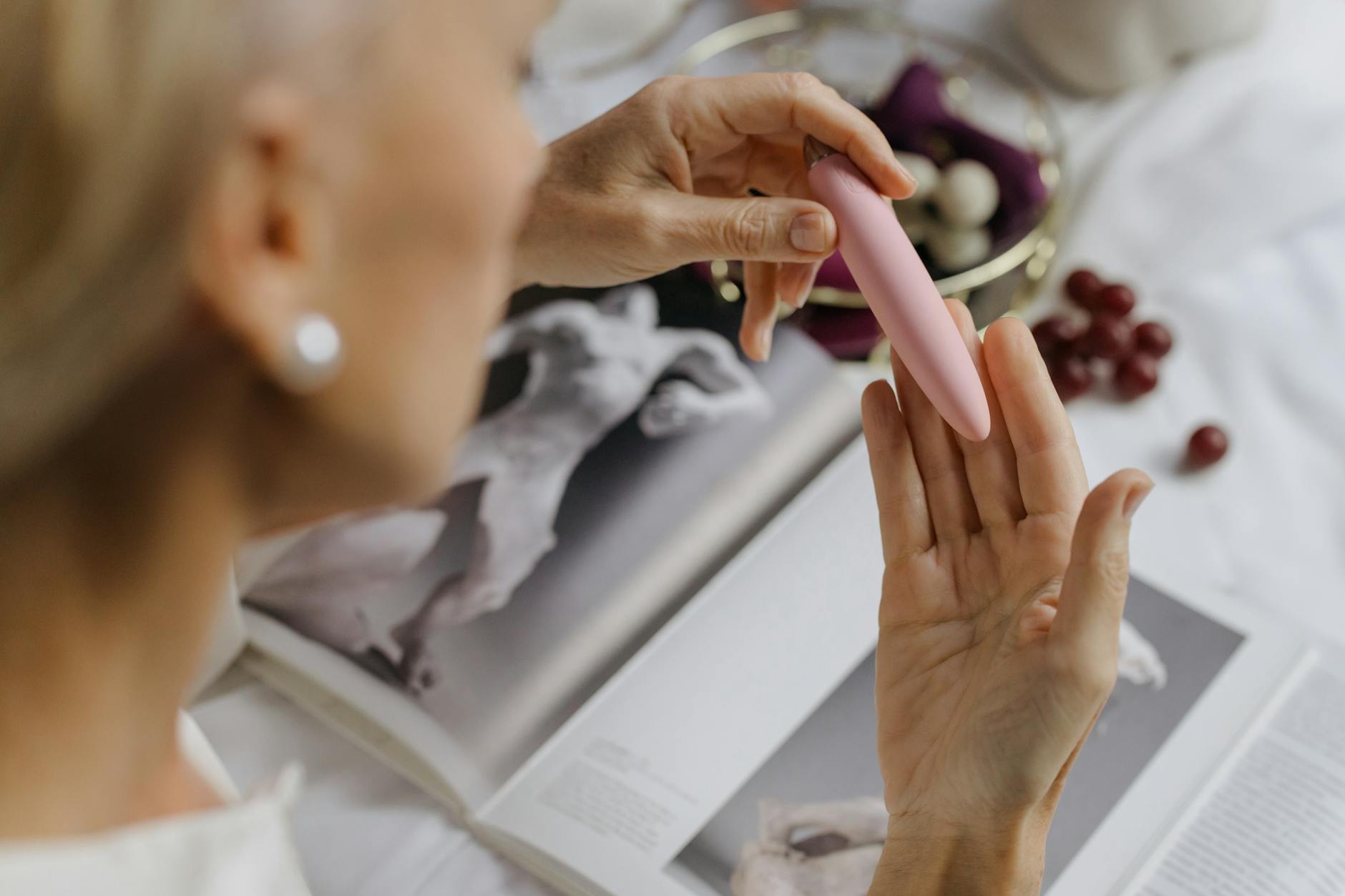
Let's talk about the sensitivity spike
Your body builds arousal. Blood flows to the clitoris, tissue swells, and within minutes what felt comfortably stimulating suddenly feels too intense. You're not broken. This is actually your nervous system doing exactly what it's supposed to do, and it's wildly common.
The problem is that most people respond to this by either grinding through the discomfort (which backfires) or stopping entirely (which kills momentum). There's a third option. And it works better than both.
Why heightened sensitivity happens during arousal
When you're aroused, your clitoris doesn't just swell. The tissue becomes more densely packed with nerve endings as blood rushes to the area. That's why light touch feels incredible at the start. It's also why, fifteen minutes later, that same touch can feel sharp or overstimulating.
This is especially pronounced if you have a smaller surface area to work with, use continuous stimulation without breaks, or have naturally sensitive tissue. It's not a sign that you're doing something wrong. It's a sign that your body is responding.
Some people experience this as a plateau. The intensity feels stuck. Others describe it as hypersensitivity where direct contact becomes almost uncomfortable. Both are the same nervous system mechanism showing up differently.
How lemon vibrators handle this differently
The lemon clitoral vibrator (and other air-suction toys like it) works differently than traditional vibration. Instead of rhythmic buzzing against tissue, it creates gentle suction waves. This distributes stimulation across a wider area rather than concentrating it in one spot.
What this means practically: when your sensitivity spikes mid-session, you can stay engaged without feeling like you're sandpapering yourself. The suction pattern keeps things moving, which your nervous system often prefers to stationary pressure.
Switch from a direct vibrator to a lemon sucker midway through arousal, and many people find they can continue building toward orgasm without hitting that wall of "too much."
The three-phase approach
If heightened sensitivity is derailing your sessions, try structuring it this way.
Phase one: Build with broad touch. Start with your hands, external massage, or a wider vibrator (like a wand) on lower settings. You're creating arousal and blood flow. Spend 5-10 minutes here.
Phase two: Shift to the Lem. Once you feel that sensitivity starting to climb (you'll know it when you feel it), switch to a lemon clitoral vibrator on pattern 1 or 2. The suction feels noticeably different from vibration, and it often resets your sensitivity threshold. You're not starting over. You're continuing with a tool that matches where your body is now.
Phase three: Layer if needed. If direct clitoral stimulation still feels sharp, use the Lem around the hood or on the surrounding tissue rather than directly on the glans. This is still stimulation. It just takes the edge off intensity.
Timing matters more than intensity
Here's what I see most often: someone reaches peak sensitivity and immediately cranks up the intensity of their current tool, thinking that's the next step. It's not. Your body doesn't need more power. It needs a different sensation.
If you're using a traditional vibrator and hit that sensitivity ceiling, switching to a lemon sucker often works better than escalating speed or pattern. You're changing the input entirely, which your nervous system reads as "new sensation" rather than "too much of the same thing."
The timing of the switch matters too. Don't wait until you're completely overwhelmed. Most people find that switching tools at the first sign of oversensitivity keeps the experience fluid and pleasurable.
Pattern switching within the Lem
If you're already using a lemon vibrator and hit that sensitivity wall, you don't need to stop. Most lemon clitoral vibrators have multiple patterns. The trick is moving down to a simpler, slower pattern rather than forward to a more complex one.
Pattern 1 is usually a steady pulse. Pattern 2 adds rhythm. Pattern 3 gets more complex. When sensitivity spikes, drop back to pattern 1. Your arousal level won't decrease. Your body will just handle the sensation more comfortably.
This is different from turning down vibration intensity. A lower-complexity pattern at the same power sometimes feels better than reduced power at high complexity. Experiment with your own device to see where your sweet spot is.
The lubrication variable
Dry tissue becomes sensitive tissue faster. If heightened sensitivity is happening too early in your session, lubrication might be part of the answer.
Water-based lube adds a layer between your body and the toy, which can soften what feels overstimulating. It also keeps tissue hydrated, which increases comfort overall. This is especially true if you're in your 40s or beyond, but it applies to everyone.
You don't need much. A dime-sized amount on and around the clitoris before you start can shift when oversensitivity kicks in and how it feels when it does.
Partnered play with sensitivity spikes
If you're using a lemon vibrator with a partner, the sensitivity conversation becomes part of foreplay communication. "My body is going to get extra sensitive around the 15-minute mark" is useful information. It's not a complaint. It's a roadmap.
Many couples find that when one partner understands this pattern, they can anticipate it. The person using the toy can switch patterns or intensity without the other person having to ask. It becomes part of the rhythm rather than a disruption.
Some people also find that their partner's touch (fingers, mouth, hand-held toy) feels different than their own when sensitivity spikes. The novelty of a different sensation often resets the threshold. If you're in a partnered situation, this is worth exploring.
Building arousal duration without hitting the wall
The longer you want your session to last, the more important pattern variation becomes. If your goal is 30 minutes of pleasure instead of 10, you need to think strategically about how you use your tools.
Most people build arousal quickly but then plateau because they hit sensitivity ceiling. Instead, think of it as a wave pattern. Build for 5-8 minutes with one approach, switch when sensitivity rises, build again, switch again. You're creating cycles rather than one long arc.
This works especially well with the Lem because the suction sensation is distinct enough from other stimulation that your body reads each switch as fresh.
When heightened sensitivity means something else
If you're experiencing sharp pain (not just "too much" sensation, but actual pain) during arousal, that's worth checking with a doctor. Conditions like vulvodynia or genitourinary syndrome can mimic ordinary sensitivity but need different approaches.
Simple oversensitivity from normal arousal usually feels like "that's too much of that sensation right now." Pain feels like something is wrong. They're different experiences and they need different solutions.
If you're consistently hitting sharp pain when aroused, a chat with a pelvic health specialist or gynecologist makes sense before assuming your toy choice is the problem.
The permission part
A lot of people treat sensitivity spikes like they've failed at pleasure. You haven't. Your body is communicating in real time, and listening to it is actually what makes extended, deeper pleasure possible.
When you switch tools or patterns or techniques in response to what your body is telling you, you're not compromising the experience. You're honoring it. The people I work with who have the longest, most satisfying sessions are the ones who are willing to shift approaches mid-stream.
Your lemon clitoral vibrator is a tool that makes this easier. Use it that way.
Frequently asked questions
Can heightened sensitivity during arousal prevent orgasm?
It can interrupt the path to orgasm if you push through it, but it doesn't have to prevent it entirely. When sensitivity spikes, the goal shifts from "more stimulation" to "different stimulation." Switching from a traditional vibrator to a lemon sucker, or dropping to a simpler pattern, often allows arousal to continue building toward orgasm. The orgasm might feel different than you expected, but it's not blocked. It's redirected.
Is heightened sensitivity a sign that I should stop using the Lem?
No. It's actually a sign that the Lem's pattern-switching and suction design become more valuable. Because the Lem creates sensation differently than a standard vibrator, it often works better when your body reaches that sensitivity threshold. You're not abandoning the tool. You're using different settings within it.
How do I know if my sensitivity is normal or if something's wrong?
Normal sensitivity during arousal feels like "that intensity is too much right now, I need something gentler or different." It happens mid-session as arousal builds. Actual pain or burning feels sharp or wrong even at low intensities and doesn't improve with tool changes or lubrication. If you're experiencing the latter, check with a doctor.
Can my partner help manage my sensitivity spikes?
Absolutely. Communication is the key tool here. Telling your partner where you are in your arousal cycle and when sensitivity usually spikes gives them information to work with. Some couples find that their partner taking over the toy use, or switching between their hands and a toy, creates novelty that resets sensitivity thresholds. Others find that pausing for 30 seconds, then resuming, gives the nervous system a reset.
Does arousal-triggered sensitivity mean I'm more sensitive overall?
Not necessarily. You might have incredibly resilient tissue most of the time but still experience normal sensitivity spikes during arousal. This is tissue responding to increased blood flow and nerve activation. It's a feature of being aroused, not a permanent trait.
Should I use lube if I'm experiencing heightened sensitivity?
Yes, usually. A water-based lube reduces friction and adds a buffer between your body and the toy. For many people, this shifts when oversensitivity kicks in and how intense it feels when it does. It's especially helpful if you're spending longer than 15-20 minutes in a session.